


Soils
Soils provide a substrate for plants and fungi to grow and habitat for invertebrates and other animals, underpinning the living ecosystem. This loose material in the upper layer of the earth’s crust is made of a mixture of minerals derived usually from the underlying rock, and dead and decaying organic matter. The air spaces between particles provide space for water storage. Generally soil layers (or horizons) near the surface have more organic material and more space for water to percolate, while those lower down have more inorganic mineral content.
Soils analysis at the OpenLiving Lab
We use are using various methods to investigate soil properties in different OpenLiving Lab areas.
- Soil structure and moisture
- Soil chemistry : pH
- Soil nutrients: Phosphorus
- Soil nutrients: Nitrogen
- Soil carbon
Soil types in the OpenLiving Lab
The soil’s characteristics depend on underlying geology, hydrology and topography. The balance of sand, silt and clay in the mineral mixture determines how fast water can permeate.
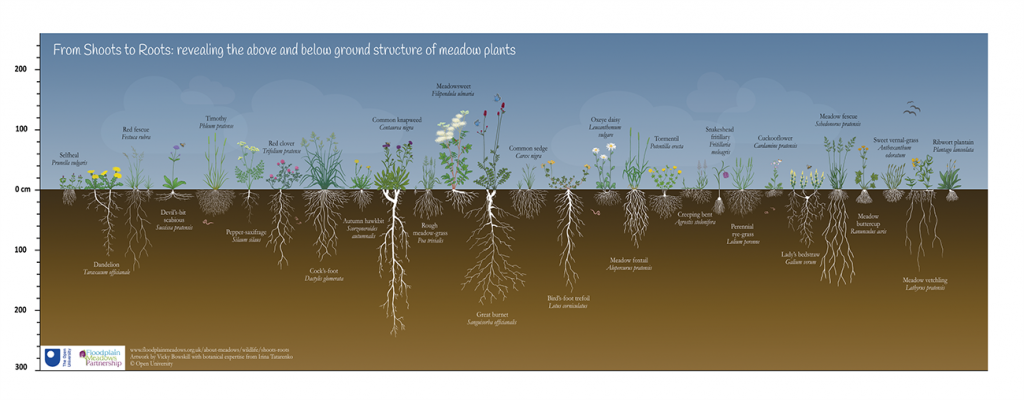
In the OpenLiving Lab’s floodplain meadow, silt is also deposited from the nearby river. The grass and herbaceous plant roots can reach up to two metres below ground, breaking up the soil and creating a store of carbon, nitrogen and other nutrients.
In the urban and riparian woodlands, nutrients are cycled seasonally as leaves grow, fall to the ground and decompose to become part of the organic matter in the soil. The leaf litter provides habitat for invertebrate detritivores that disturb the soil, and larger insectivores dig through the leaf litter and soil when foraging.
In an urban environment, soil can become more compacted where people walk, and there may also be a build-up of pollutants from the air or water runoff, which could include plastics, lead, zinc and copper, as well as excess nitrogen, phosphorus, sulphates and CO2.
As the ecosystems are restored we are monitoring the soil moisture, soil compaction, soil chemistry and nutrient composition to see how the different layers of soil are adapting to changes in management.
References / Further reading
Soil sampling and methods of analysis (second edition). 2006. Edited by M.R. Carter & E.G. Gregorich. CRC Press, Boca Raton, Florida, USA.
Water Storage Capacity of Soils – Scoping Study.


