

Birds
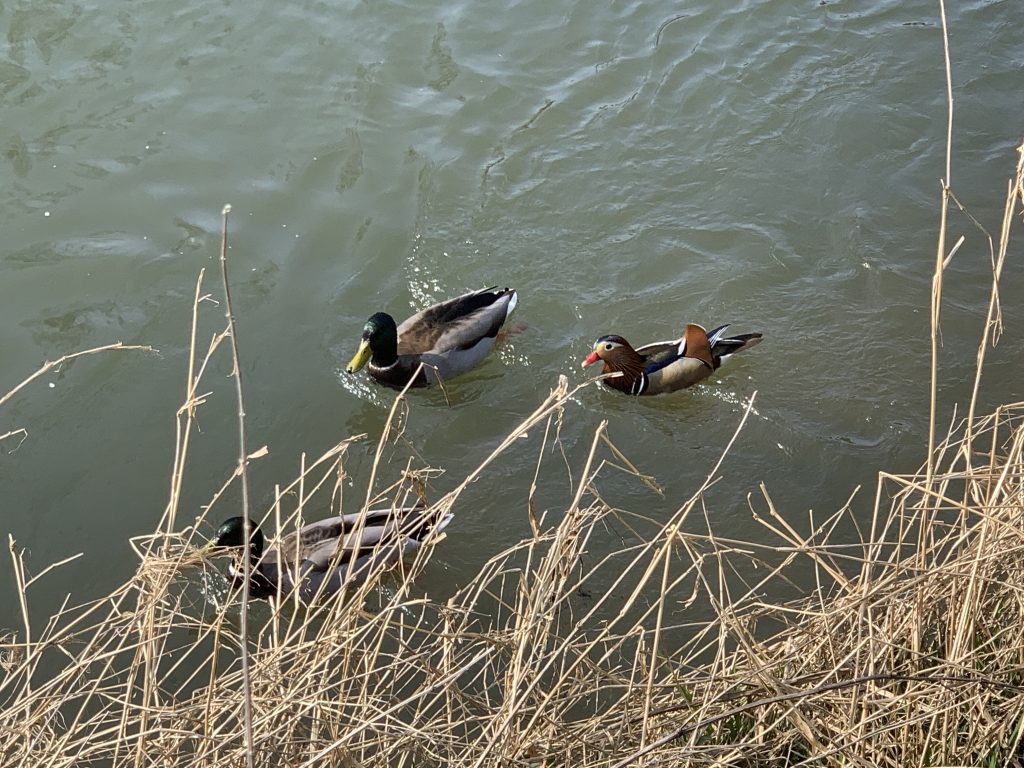
Birds are an important, diverse, and engaging part of urban wildlife. In towns and cities, they provide valuable ecosystem services, including insect pest control and seed dispersal, while also enhancing everyday experiences of nature and supporting human wellbeing and human–nature connection. Nationally, however, bird populations in the UK have declined substantially, with an overall decrease of around 48% since the 1970s. Farmland birds have fallen by 62% over this period, woodland birds by approximately 32%, and seabirds by around 37%, with some species experiencing particularly severe losses, such as Willow Tits (Poecile montanus) declining by 94% and Turtle Doves (Streptopelia turtur) declining by 98%, which are both likely to become nationally extinct without conservation action.
Audio detection of birds
To understan the birds we have at the OpenLiving Labs as well as monitor how their populations change as our restoration efforts take effect, we have several sensors that record bird songs and calls (otherwise known as acoustic loggers) to identify the birds we have around the site. We employ the use of high tech but low-cost Audiomoth sensors, so named after moths which can detect sounds at high frequencies.
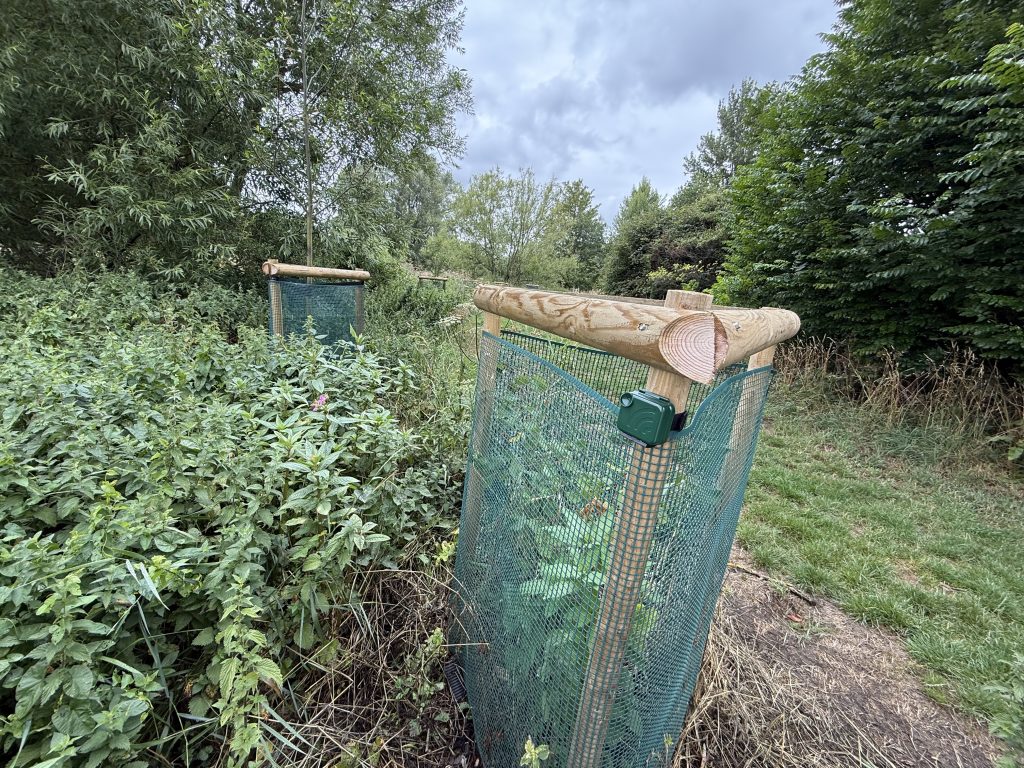
By recording sounds across the site at a frequency range typical of birds (2 – 12 kHz), we can filter out much of the urban noise and really focus in on the birds calling. The current schedule is to record during the Dawn Chorus—a highly active period of birdsong in the early morning. This captures a huge amount of data, more than we have time to sift through, and therefore we are utilising cutting-edge technological advances in bird-audio identification using the machine learning BirdNET platform. This software allows us to upload a large number of audio clips for rapid identification, filtering the outputs by confidence of identification and co-ordinates to give the highest plausible identification. The outputs are then manually verified to be plausible in a batch-sample and recorded on our database.
You can listen to an example of a track recorded at the OpenLiving Labs above. As well as the characteristic Robin song, which is the most prominent singer in the clip, there are several other birds in the mix, including the Great Tit (Parus major), and the Green Woodpecker (Picus viridis).
Other birds that are not picked up by the audiomoths are also present at the labs. This highlights how important that sampling in multiple ways can be to truly reflect the species diversity of an area.
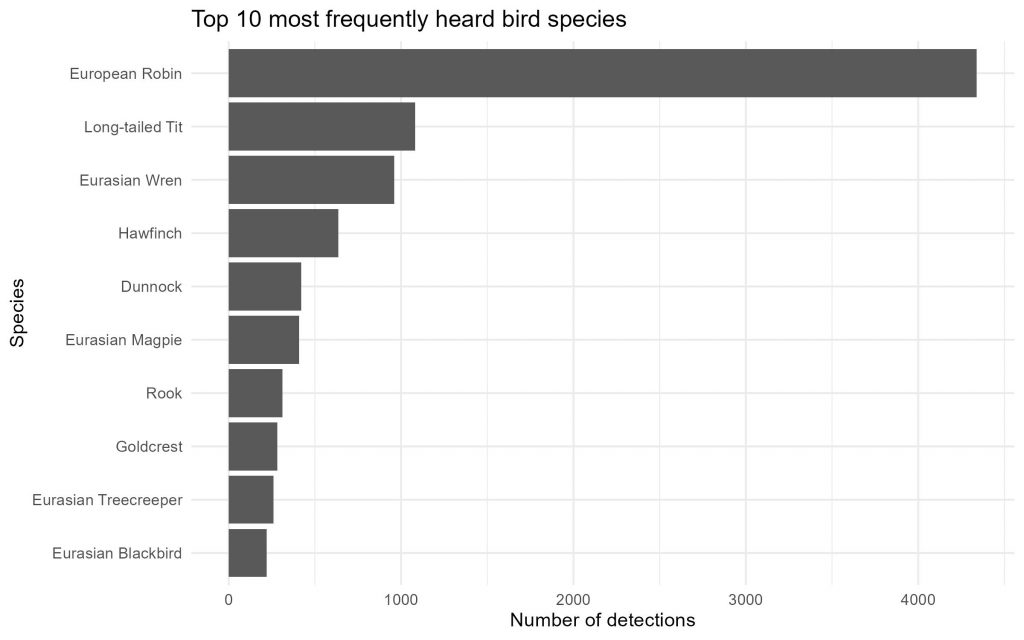
Below you can see the top 10 birds most frequently heard on the Audiomoth sensors. European Robins were the most detected, but this could be the same, or a few individual Robins with loud and consistent songs.
A list of the wider range of species detected by the acoustic loggers and identified by BirdNET in August 2025 can be seen in the table below, including their Red List status. The presence of rarer birds like Marsh Tits, Lesser Spotted Woodpeckers and Wood Warblers shows that this patch of woodland is valuable habitat for these species and well connected to the wider countryside.
| Common name | Scientific name | UK Conservation status |
| Barn Owl | Tyto alba | Green |
| Common Buzzard | Buteo buteo | Green |
| Common Chiffchaff | Phylloscopus collybita | Green |
| Common Kingfisher | Alcedo atthis | Green |
| Eurasian Blackcap | Sylvia atricapilla | Green |
| Eurasian Blue Tit | Cyanistes caeruleus | Green |
| Eurasian Green Woodpecker | Picus viridis | Green |
| Eurasian Jackdaw | Corvus monedula | Green |
| Eurasian Jay | Garrulus glandarius | Green |
| Eurasian Magpie | Pica pica | Green |
| Eurasian Siskin | Spinus spinus | Green |
| Eurasian Treecreeper | Certhia familiaris | Green |
| Eurasian Wren | Troglodytes troglodytes | Amber |
| European Robin | Erithacus rubecula | Green |
| Goldcrest | Regulus regulus | Green |
| Gray Heron | Ardea cinerea | Green |
| Gray Wagtail | Motacilla cinerea | Not assessed |
| Great Spotted Woodpecker | Dendrocopos major | Green |
| Great Tit | Parus major | Green |
| Lesser Spotted Woodpecker | Dryobates minor | Red |
| Long-tailed Tit | Aegithalos caudatus | Green |
| Marsh Tit | Poecile palustris | Red |
| Pied Wagtail | Motacilla alba | Green |
| Redwing | Turdus iliacus | Not assessed |
| Carrion Crow | Corvus corone | Not assessed |
| Stock Dove | Columba oenas | Amber |
| Tree Pipit | Anthus trivialis | Red |
| Wood Warbler | Phylloscopus sibilatrix | Red |


